Part 2: Safety
Where does the feeling come from? Where does it go?

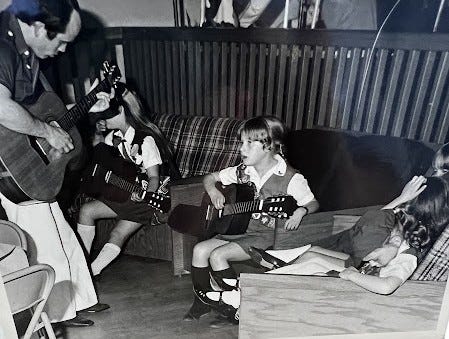
When I think about safety, I don’t think about rules or locks or protocols. I think about a feeling, one so steady and ever‑present in my childhood that I didn’t even know it was there until it was gone.
Safety, for me, came from the world itself. From the island. From the way the ferry cut us off from everything loud and unpredictable. From neighbors who knew your name and your parents’ names and your dog’s name. From the sense that nothing bad could reach you unless you invited it in.
It wasn’t something anyone talked about. It was something you breathed.
But feelings like that are fragile. They don’t always follow us into adulthood. And they certainly don’t follow kids into the world they’re growing up in now. Even in my sheltered childhood, stories of the Green River killer infiltrated the filters. I was certain the creek I walked past on my way to the bus stop looked a lot like a green river. Even then my mom was able to soothe me with the fact that those things were not happening on our island.
So where does that feeling go?
Sometimes it fades quietly, replaced by the awareness of danger, of unpredictability, of the thousand invisible pressures kids carry today. Sometimes it gets drowned out by noise: the news, the internet, the constant hum of comparison and performance. Sometimes it gets replaced by vigilance, by the sense that you must watch your own back because no one else will.
And sometimes, it doesn’t disappear at all. It just moves. It relocates. It finds new places to live.
For many kids, that place is the classroom.
Not because school is perfect or peaceful or predictable, it rarely is, but because it’s one of the few places where safety can still be felt, not just enforced. Where an adult’s presence can soften the edges of a hard day. Where routines create a rhythm kids can trust. Where someone notices when they’re quiet, or off, or hurting.
Safety used to come from the environment. Now it comes from people.
And that’s where community and safety braid together. You can’t really separate them. Community is the structure; safety is the feeling inside it. One gives shape, the other gives breath.
Kids feel safe when:
• they know who will be there
• they know what to expect
• they know someone will notice if they’re not okay
• they know they belong to a group that holds them
That’s the part we forget. Safety isn’t just the absence of danger. It’s the presence of care.
Kids want to feel held by something bigger than themselves. They want to feel protected by the collective. They want to know the world won’t fall apart if they look away for a moment.
And maybe that’s the real work of safety now, not building walls, but building relationships. Not shielding kids from the world but giving them a place where the world feels a little less sharp.
Safety used to come from isolation. Today, it comes from connection.
And if community is the village we build, safety is the feeling that tells kids they can grow inside it. And if I’m really being honest, a lot of us adults need this too.